


Optimizing Backfill in Industry 4.0
In the current paradigm of Industrial Digital Transformation, the maturity of an infrastructure is not measured by its ingestion capacity under nominal conditions, but by its resilience to asynchrony.
One of the most critical vectors of inefficiency in modern organizations is Backfill: the process of integrating historical data flows that arrive late or out of sequence. What is often categorized as a simple technical issue is, in reality, a symptom of legacy architectures that were not designed for the volatility and decentralization of today’s data.
The Critical Nature of Backfill in Distributed Environments
Backfill represents the challenge of reconciling the timeline of physical assets with the technical reality of communication networks. In an ideal industrial ecosystem, data flows linearly; however, operational reality imposes complex scenarios:
- Store & Forward Systems: Edge gateways store information during connectivity interruptions, releasing it in bulk once service is restored.
- Asynchronous Protocols: The rise of IoT and networks such as 5G or satellite introduce latencies that alter the order in which data packets arrive.
- Historical Data Integration: The consolidation of silos from migrations, file exchange systems, or manual records that must coexist with real-time data flows.
For organizations aiming for evidence-based decision-making, backfill is a determining factor in data integrity. Without native handling of out-of-order data, advanced analytics models and key performance indicators (KPIs) lose their structural validity.
The Technological Ceiling of File-Based (Legacy) Architectures
Most traditional historian systems, designed under assumptions from three decades ago, operate using a sequential write model into closed binary files. This architecture presents limitations that today represent a risk to scalability:
Re-indexing Friction
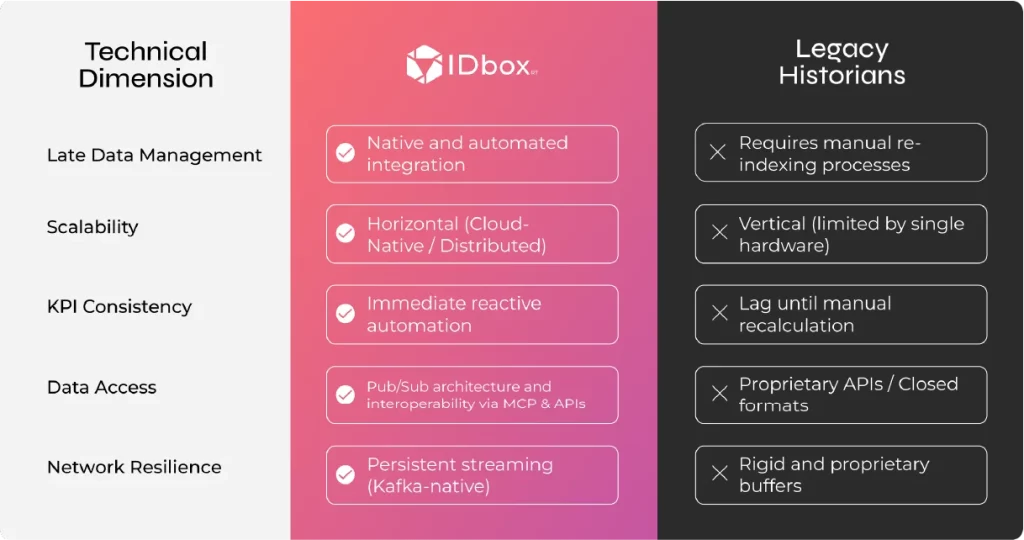
In file-based systems, inserting historical data requires reopening previously sealed structures. This process demands massive CPU cycles to decompress, insert, and re-index information. The result is increased latency that directly impacts the visualization and monitoring of current operations.
Degradation of Compression Efficiency
Temporal compression algorithms (such as swinging door) are optimized for ordered data. When faced with backfill flows, these systems often fail to correctly recalculate exceptions, resulting in oversized databases and loss of fidelity in historical reconstruction.
Dependence on Proprietary Formats
Storage in binary “black boxes” hinders interoperability. Retrieving historical data for Business Intelligence (BI) tools or Artificial Intelligence requires, in these systems, intermediate APIs that act as both technical and financial bottlenecks.
IDboxRT: A Paradigm Shift Towards Industrial Streaming
IDboxRT proposes a fundamental architectural evolution: moving from static persistence to a Native and Decoupled Streaming model. This approach allows the infrastructure to be agnostic to when data is received, ensuring business continuity and analytical accuracy.
A. Idempotent Ingestion through Event Streaming (Apache Kafka). Through an event bus based on Apache Kafka, IDboxRT separates acquisition from persistence.
- Operational Resilience: The system acts as a dynamic buffer capable of absorbing massive bursts of historical data without impacting the performance of the core engine.
- Uniqueness Guarantee (Idempotency): Our architecture ensures that data re-ingestion (common in backfill processes) does not generate redundancies, maintaining a single source of truth without manual intervention.
B. Elastic Persistence in Hypertables (TimescaleDB)
We replace rigid storage with next-generation time-series engines. The use of hypertables enables intelligent partitioning: inserting data from months ago is technically as efficient as ingesting current millisecond data, eliminating the need for costly re-indexing.
Added Value: Reactive Aggregations and Data Integrity
The true potential becomes evident in post-ingestion processing. While legacy systems require manual processes to correct KPIs after backfill, IDboxRT implements a reactive computation engine.
When the system detects an insertion with a past timestamp, it automatically triggers the recalculation of variables that have dependencies. This ensures that the company’s Unified Name Space (UNS) is dynamically updated, guaranteeing that dashboards always reflect a complete historical reality.
Use Cases: Resilience in Critical Sectors
- Renewable Energy: In wind or photovoltaic farms with satellite connections, backfill is a daily operation. IDboxRT allows days of inactivity to be recovered in minutes, ensuring accurate energy balancing for settlement.
- Logistics and Cold Chain: In-transit sensors that upload historical data in batches. Our architecture integrates this data seamlessly, enabling quality audits without temporal gaps.
- Smart Cities: Management of large sensor networks with different sampling frequencies and network delays, where data convergence is critical for public service management.
Data Sovereignty: Standard SQL vs. Closed Ecosystems
One of the pillars of our approach is Data Sovereignty. By using open standards and native SQL access, IDboxRT eliminates vendor lock-in. Data recovered through backfill is immediately available for use in PowerBI, Grafana, or advanced Machine Learning models, without the need for costly proprietary connectors.
From Data to Decisions: Business Impact
This debate is not merely academic or technical. It has a direct impact on decision-making. If your system is not capable of properly integrating out-of-order data, it directly affects your business:
- You will lose the ability to modify your data and will spend time and effort performing recalculations and validations.
- Your OEE reports will remain inconsistent until a manual correction process is completed.
- Your Machine Learning models will be trained on incomplete timelines, reducing their accuracy.
- Your energy balance will not reconcile, making compliance with sustainability regulations more difficult.
The real leap in digital transformation is not about accumulating more data, but about building an infrastructure that does not depend on the world being perfect. Order should not be a prerequisite, but a guarantee of the system.
Ready to evolve your data strategy?
If backfill is still a tedious manual task or if your current historian system has become a bottleneck for your growth, it’s time to move toward flexible, open architectures.
Contact our team of experts to discover how IDboxRT can help you centralize, historize, and leverage your industrial data, regardless of when or how it arrives.
Leave a Reply