

Traditional Historian in Utilities
Engineering Tools, Not Organization-Wide Platforms
Most historians running in utilities today were born as tools for a small engineering team: capture process signals, store them, let a handful of specialists query them when needed. That lineage still shows, twenty years later, even though the business around it has completely changed.
Today’s utility isn’t an engineering team with a data archive. It’s a control room running rotating shifts, a maintenance department that needs to see trends before an asset fails, leadership that wants KPIs without asking someone to pull a report, and a growing sensor count driven by smarter grids, smart meters, and IoT. The historian is still built for the first scenario. The utility already lives in the second.
The Hidden Tax: Paying for Products, Not a Platform
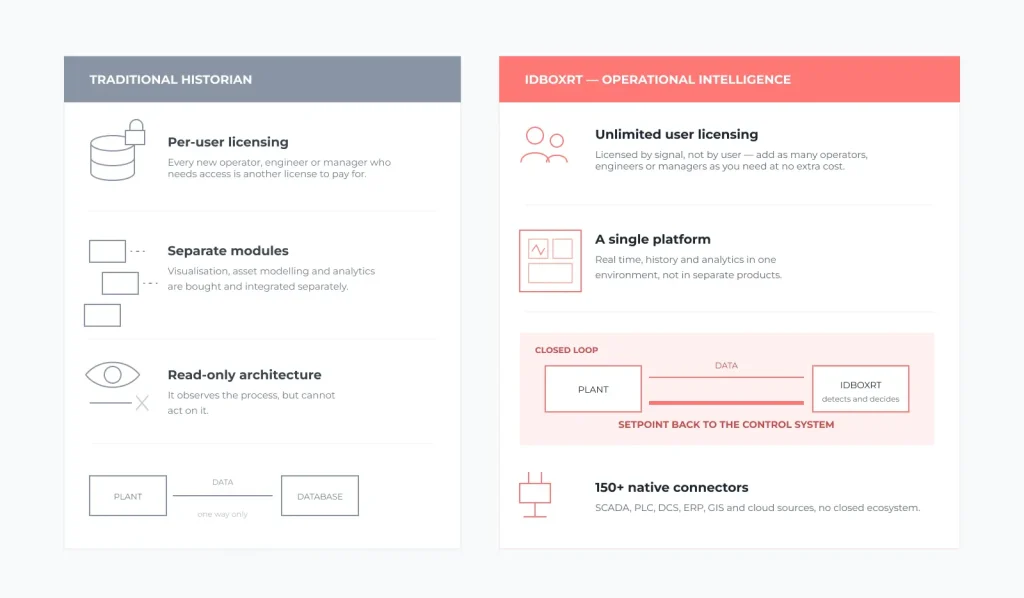
Here’s the first real problem, and it’s architectural, not just pricing. A classic historian is almost never one product — it’s a storage core, plus a separate module for asset modeling and hierarchies, plus another for visualization, plus another for cloud or third-party integration. Each one is licensed separately. Each has its own learning curve. Each needs to be kept up to date on its own schedule.
The result isn’t a platform — it’s a stack of products that happen to coexist because you bought them all from the same vendor. When someone asks “how much does our historian cost us?”, the honest answer is almost never a number. It’s a list.
The Question Nobody Asks Until It’s Too Late: Does It Observe, or Act?
The second problem runs deeper. A traditional historian was built for one specific purpose: keeping a record of what happened, for audits, analysis, and regulatory compliance. It wasn’t built to act on the process. That’s not a missing feature you can patch with an update — it’s the reason the product exists in the first place.
That means when the system detects a valve behaving abnormally, or a substation approaching a limit, the platform tells you. Full stop. Closing the valve, adjusting the setpoint, or sending a command back to the control system still depends on another tool, or on someone stepping in manually. The data and the action live in separate worlds — by design.
Migration Isn’t Scary Because of the Technology. It’s Scary Because of the Format
The third problem shows up once you finally decide to move. Years of historical data — arguably the most valuable asset your operation has for understanding its own behavior — usually live in a proprietary format, built to be read by that historian and nothing else. Migrating it isn’t copying a file. It’s a project of its own, with the risk of losing visibility right in the middle of the transition — exactly when you need it most.
Where a Utility Actually Fits: Multi-Infrastructure, Not Single-Plant
There’s a fourth problem that rarely gets mentioned: most of these historians were built with a single industrial plant in mind, not a utility running electric grid, water, and gas at the same time, each with different protocols, capture rates, and reporting requirements. Fitting all of that into a tool designed for one plant means forcing the architecture, not using it as intended.
The Electric Grid Case: When Reaction Speed Is the Business
On an electric grid, the “observe but don’t act” problem isn’t just inconvenient — it’s directly the cost of an outage. When a historian detects a voltage deviation at a substation or an anomaly on a feeder, knowing about it ten seconds sooner doesn’t help much if the only way to react is picking up a phone or opening another tool to operate the breaker.
This is exactly where grid digitalization — smart meters, distributed substation sensors, feeder-level telemetry — multiplies the number of signals in the scenario where a per-user licensing model hurts the most: more people in the control room needing to see the same data at the same time, in real time, during an incident.
IDboxRT’s ability to send setpoints back to the control system isn’t just another item on a feature list — on an electric grid, it means being able to act on a breaker, a switching operation, or a demand response event from the same platform that detected the anomaly, without routing through a separate system. That’s the difference between a historian that documents the incident and a platform that helps resolve it while it’s happening.
Where IDboxRT Stands
IDboxRT was built to solve these problems from the ground up, not as a patch:
- One platform, not a stack of products. Real-time, historical, visualization, asset modeling, and analytics live in a single environment. There’s no separate module to buy for each function.
- Closes the loop between data and action. IDboxRT isn’t read-only — it can send setpoints back to the control system, connecting anomaly detection directly to a response on the process, without relying on an external tool.
- Signal-based licensing, with unlimited users at no extra cost. This matters because of how a utility actually works: if giving access to one more shift operator, maintenance engineer, or executive spikes the invoice, the organization ends up restricting who can see the data. IDboxRT removes that incentive — it bills by signal captured, not by person with access.
- Migration without replacing instrumentation, historical data included. IDboxRT deploys on top of your existing control systems and lets you import and normalize prior historical data, without forcing you to run two platforms side by side longer than necessary.
- 150+ native connectors with SCADA, PLC, DCS, ERP, GIS, and cloud sources, built to coexist across multiple types of infrastructure — electric, water, gas, telecom — within the same repository, instead of forcing a single-plant tool to cover a multi-network operation.
At the energy, water, and gas utilities we’ve worked with, this approach changed something fundamental: the whole team gets access to real-time data, not just whoever had a license left, and the operation can act on what it detects instead of just watching it happen.
FAQ
- What sets IDboxRT apart from a traditional historian in utilities?
Three concrete things: it’s a single platform instead of several modules you have to buy separately, it can send setpoints back to the control system instead of only displaying data, and it’s licensed by signal captured, not by person with access. - Why does signal-based vs. user-based licensing matter so much?
Because in a utility, a lot of different people need to see the same data — shift operators, maintenance, engineering, leadership. If every new person spikes the bill, the organization ends up restricting access exactly where the data would create the most value. - Can I migrate my historical data to IDboxRT without losing anything?
Yes. IDboxRT captures data directly from your existing control systems and lets you import and normalize prior historical data, without replacing instrumentation already in place. - Does it work across electric, water, gas, and telecom networks at once?
Yes — and it’s one of the clearest ways it differs from historians built for a single plant: it’s designed to handle different processes and protocols within the same repository.
Keep reading: → Legacy Systems in Utilities: Flexibility and Cost Without Stopping Operations — the full guide on when and how to migrate.
Is your current historian still built for an engineering team, not your whole utility? Talk to our team → and find out if IDboxRT can give you a single platform, real ability to act, and a cost that doesn’t depend on how many people need to see the data.
Leave a Reply