


Real-Time Monitoring for Renewable Gas Plants
How a Renewable Gas Producer Moved From Monthly Reports to Real-Time Monitoring of Its Biomethane and Green Hydrogen Plants
The sector: renewable gas production, a business growing faster than its ability to measure itself
Biomethane and green hydrogen are, today, two of the most heavily invested vectors in Spain’s energy transition. But the sector’s growth has a particularity that doesn’t always get told: plants are multiplying faster than companies’ ability to get a combined view of how they’re performing.
This is the case of a Spanish renewable gas company, with a portfolio of dozens of biomethane and green hydrogen projects at different stages of development and operation. Every new plant added data — but it didn’t add visibility. Information kept living plant by plant, with no shared repository to compare performance or catch problems before they affected production.
The problem: data that exists but can’t be used in time
Before working with IDboxRT, these plants were run on an operating model that’s common across the sector — one any O&M manager at a renewable gas generation plant will recognize:
- Each plant reported on its own. There was no single repository to check the status of every facility at the same time.
- Performance was known after the fact. The main tracking channel for one of the portfolio’s most significant plants was a report sent at the end of the month — meaning any deviation in production, flow rate, or biogas composition was detected weeks after it happened, not when it happened.
- There was no way to calculate the economic performance of each plant in real time — critical in a business where margin depends on variables that change hour by hour (gas composition, flow rate, process power consumption).
- Business scalability collided with monitoring scalability. Adding a new plant to the portfolio wasn’t just a construction challenge — it was a digitalization challenge too: without a common platform, every new facility started from zero.
The challenge wasn’t getting more data — the plants already generated plenty of telemetry. The challenge was turning that scattered data into a single repository that could support daily decisions, not monthly ones.
The solution: local data capture, a unified data structure, and a single point of control in the cloud
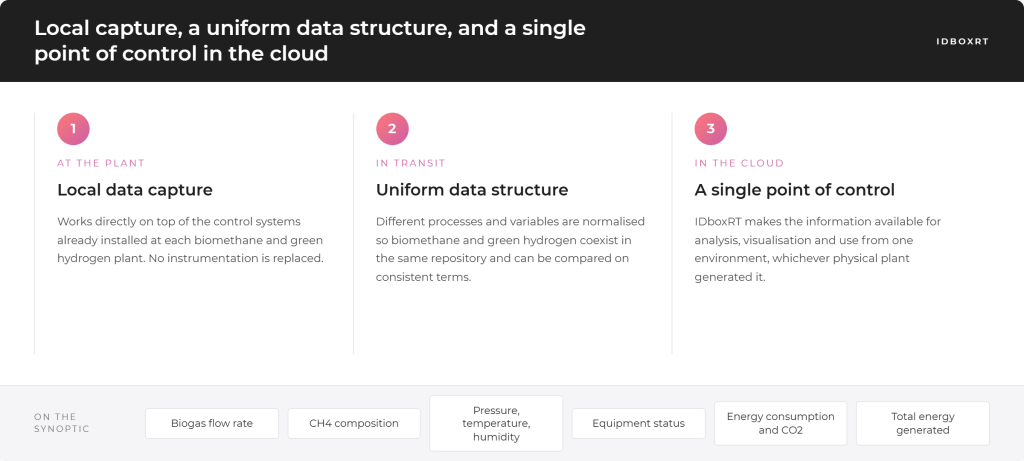
The company deployed IDboxRT as the monitoring platform for its renewable gas generation assets, structured across three layers:
- Local data capture at each plant (biomethane and green hydrogen), working directly on top of the existing control systems, with no need to replace instrumentation already in place.
- Normalization into a uniform data structure, so a biomethane plant and a green hydrogen plant — with different processes and variables — could coexist in the same repository and be compared on consistent terms.
- Transmission to IDboxRT in the cloud, where the information becomes available for analysis, visualization, and use from a single environment, regardless of which physical plant generated the data.
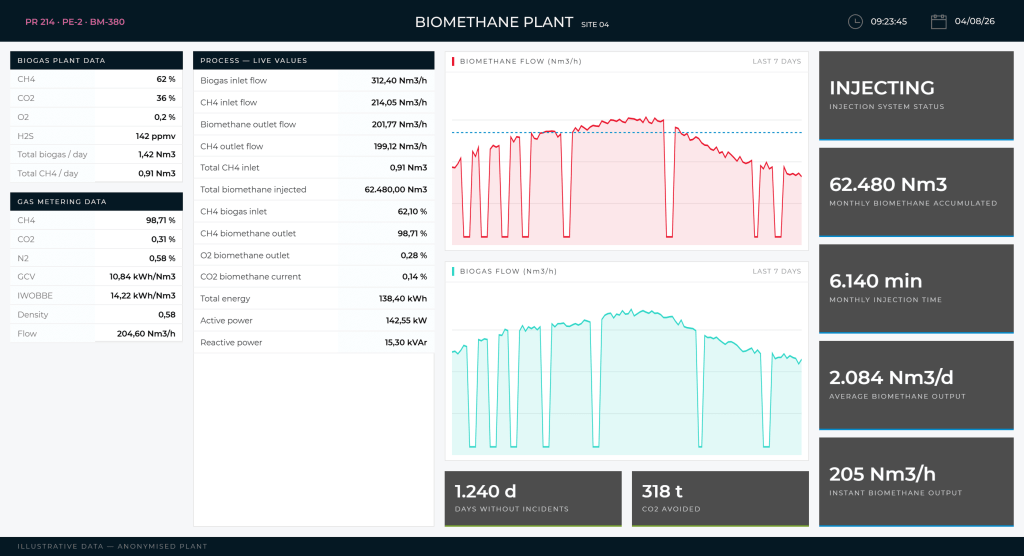
On top of that foundation, plant-specific synoptic views were deployed with:
- Incoming biogas flow rate, composition (CH4), and real-time process equipment status.
- Environmental and process condition panels (humidity, pressure, temperature).
- Energy consumption and associated CO2 output.
- Total energy generated, broken down by source.
All of this replaced the previous “monthly PDF or spreadsheet report” workflow with a live, always-available synoptic view — and laid the groundwork for the next step: calculating each plant’s economic performance in real time, instead of reconstructing it after the fact.
The results
- From monthly report to real-time data. Plant performance tracking no longer depends on an end-of-month send-off: it’s now checked in the moment, with full historical data always available for retrospective analysis.
- A single repository for a multi-plant, multi-technology portfolio. Biomethane and green hydrogen now coexist in the same monitoring environment, with a consistent data structure — something the company itself identifies as a business necessity rather than a technological “extra.”
- Earlier detection of technical or performance deviations, moving from a monthly review to continuous monitoring of flow, composition, and consumption.
- Groundwork laid for real-time calculation of economic performance per plant — one of the next steps already identified on the project roadmap.
- Significant reduction in incident detection time.
As a sector-wide reference — not attributed to this specific client — industrial and generation plants that have adopted real-time monitoring with IDboxRT have recorded improvements of between 15% and 40% in energy efficiency, along with meaningful reductions in maintenance cost and unplanned downtime.
What this case means for any renewable gas operator
This isn’t a quirk unique to biomethane or hydrogen — it’s the pattern that repeats across any gas infrastructure, conventional or renewable, that grows faster than its ability to measure itself. The question any O&M manager should be asking isn’t “do we have data?” It’s:
- Can we see the status of all our plants from a single point, right now?
- Do we know what happened in the last few hours, or only what happened last month?
- Does our data platform scale at the same pace as our asset portfolio, or does every new plant start from zero?
If the answer to any of these makes you uncomfortable, you’re probably already paying the cost of not having real-time data — even if that cost never shows up as a line item on any budget.
Does your renewable or conventional gas operation face the same challenge? Contact us and find out how IDboxRT can unify monitoring across your plant portfolio in a single environment — without replacing your current instrumentation.
Leave a Reply