

Real-Time Traceability in the Food Industry
Traceability is no longer just a legal requirement
Since January 2026, the European Union has required digital traceability for fishery and aquaculture products — paper delivery notes and photographs are no longer valid as evidence during an inspection. It is not an isolated case: it is the most recent application of a principle the food sector has seen coming for years, already set out in Article 18 of the EU General Food Law Regulation, and one the United States is advancing in parallel with its own traceability rule (FSMA 204).
The direction is clear, and it is not limited to fishing: more and more food and beverage subsectors — dairy, canned goods, packaged beverages, fresh produce — will have to prove, with verifiable data and within ever-shorter deadlines, where each batch comes from and where it has been. The question is no longer whether it will affect you, but when.
For most plants, this exposes a structural problem: the data exists, but it is scattered across spreadsheets, paper production logs and control systems that don’t talk to each other. Rebuilding a batch’s traceability by hand, with an audit knocking at the door, stops being viable as soon as the response time is measured in hours rather than weeks.
The number nobody tells you: your real OEE is lower than you think
This is the part almost no vendor connects to traceability, and the one we at IDboxRT consider the missing piece in most food and beverage digitalization projects.
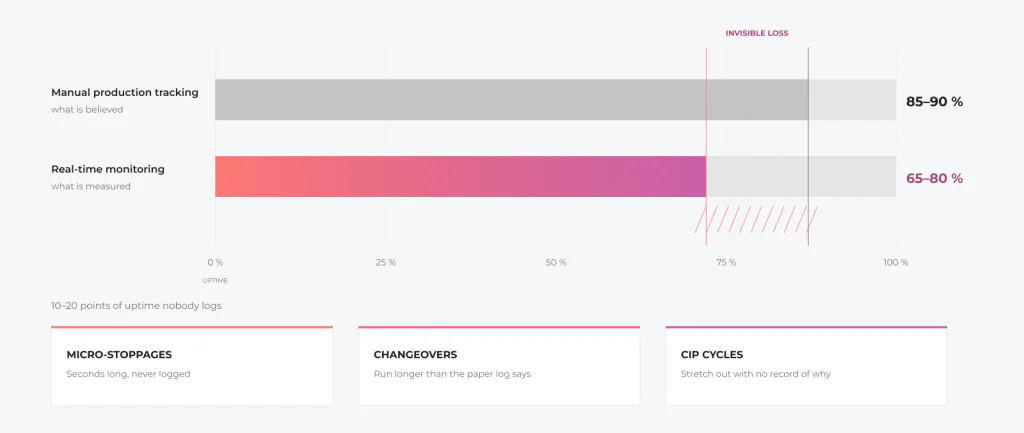
Most plants that track production manually believe they operate at 85–90% availability. Once they start monitoring in real time, the real figure is usually between 65% and 80%. The difference isn’t major breakdowns — it’s invisible losses: micro-stoppages nobody logs because they last seconds, changeovers that run longer than they appear on paper, CIP (Clean-in-Place) cycles that stretch out with no record of why.
What matters is this: they are exactly the same kind of events you need to capture to comply with traceability. A system that records when each batch starts and ends, at what temperature, on which line and with which parameters, is generating — with no extra effort — the same data that tells you where production, energy or time is slipping away.
Why Standalone Solutions Fall Short
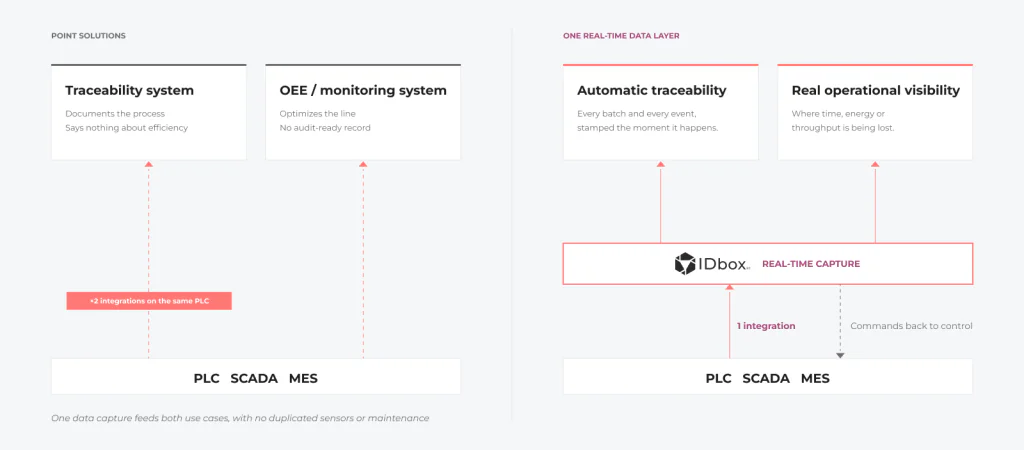
Two main types of solution coexist in the market: traceability systems that document the process but say nothing about efficiency, and OEE/monitoring systems that optimize the line but don’t produce an audit-ready record for an inspection. Treating them as separate projects means paying twice to capture the same plant data, with two different integrations on the same PLC or SCADA.
The alternative — and where we believe the market is heading in the coming years — is a single real-time data layer that feeds both use cases at once, instead of duplicating sensors, connections and maintenance.
One real-time data layer, two problems solved
IDboxRT connects directly to your existing PLC, SCADA and MES systems — without replacing them or requiring a migration along the way. From there, the same real-time data capture serves two purposes at once:
- Automatic traceability: every batch, every temperature reading, every process event is recorded at the exact moment it happens, ready for an audit or a regulatory request, without depending on someone writing it down by hand
- Real operational visibility: the same data that documents the process also reveals where time, energy or throughput is being lost — turning a regulatory obligation into a lever for continuous improvement
- The ability to act, not just observe: unlike a simple passive record, a well-designed data layer can also send commands back to the control systems — for example, adjusting a process parameter in response to a detected deviation, instead of just raising an alert and waiting for someone to act manually
What does “real time” mean in practice?
It’s a term that is used a lot and defined little. In practice, there is an important difference between a system that queries data every few minutes (polling) and one that reacts to each event the instant it happens. For regulatory traceability, the difference is critical: if your system only consolidates data at the end of the shift, technically you don’t have real-time traceability, you have a delayed historian — and that delay is exactly what an audit can call into question.
What to Consider Before Choosing a Traceability Solution
- Does it automatically capture data from the plant, or does it rely on someone entering it manually?
- Does it integrate with your current SCADA/PLC/MES, or does it require replacing it entirely?
- Is the data available as it occurs, or is it only consolidated at the end of the shift?
- Can it scale from a single floor to multiple floors without having to rebuild the integration from scratch each time?
- Does the system simply record data, or can it also intervene in the process when it detects a deviation?
Where is this going?
Based on our experience supporting OT/IT convergence projects across various industrial sectors, our assessment is that traceability and sustainability will converge sooner than many plants expect: the same data that is currently used to verify the origin of a batch will also be used tomorrow to report carbon footprints and energy consumption per product, as regulatory pressure and pressure from major distributors push in that direction. Plants that build their real-time data infrastructure now, with both uses in mind, will not have to rebuild their infrastructure when the next wave of regulations arrives.
Turn Regulatory Requirements into Operational Advantages
Traceability is no longer just a box to check before an inspection. With the right infrastructure, the same data that protects you during an audit is what tells you, right now, where you’re losing production.
Leave a Reply