

Above the SCADA
The layer that turns multiple systems into a single operation
A SCADA is not the problem
The SCADA fulfills a mission no one questions: supervising and controlling infrastructure in real time based on signals from sensors and PLCs. That is why the conversation about its future is so often framed the wrong way, as if the challenge were to replace it. In most organizations, the SCADA works. What fails is what it is asked to do as operations grow: to also consolidate, contextualize and analyze what happens across dozens of sites.
That limit appears when several SCADAs coexist, one per region, plant or vendor, alongside PLCs, management systems and analysis tools. Each does its part well, but none sees the whole operation.
When each system shows a different part of the operation
Understanding a single situation means opening several screens. That is why many decisions are still made with spreadsheets, manual reports and calls between teams. The data exists, but it is scattered across systems that do not talk to each other. It is one of the most common faces of OT/IT convergence, and it is rarely a capture problem. What is missing is a shared view to decide from.
A single layer on top, without replacing what already works
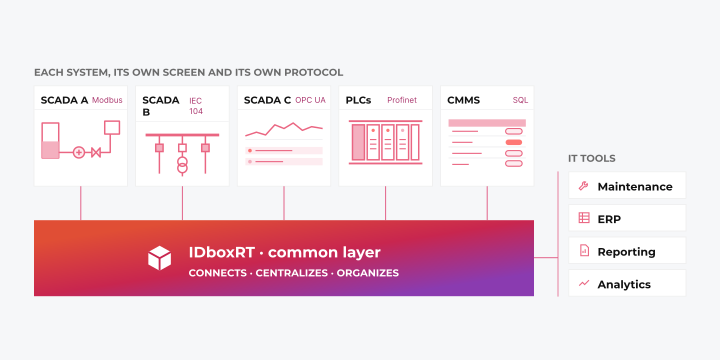
IDboxRT connects to existing SCADA, PLC and MES systems, without replacing them or requiring a system migration along the way. From there, the same layer adds three things:
Connection regardless of origin
Systems are integrated regardless of their vendor or protocol, instead of forcing a rebuild of the control architecture.
A single view of the operation
Data is centralized and organized in real time, so that plant, maintenance and management all look at the same thing.
IT integration without custom development
Data reaches corporate tools through a common path, rather than through a different integration for each one.
And, when the architecture allows it, the layer can close the loop: send setpoints back to the control systems instead of just alerting. It is not a faster smart historian. The value lies in what is done with the data once all systems speak the same language.
A power grid case: real time and analysis don’t fit in the same system
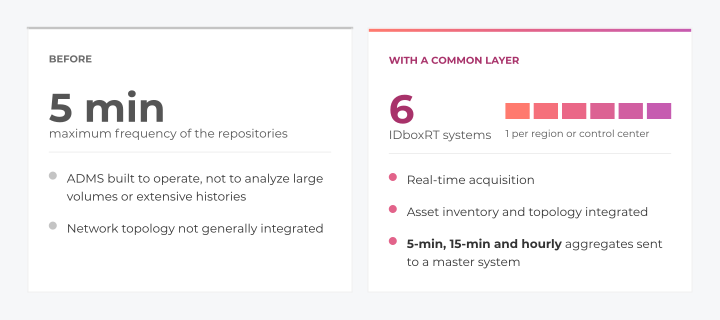
In i-DE’s distribution grid, the ADMS systems cover what they are meant to cover: following the operation and acting immediately on remotely controlled devices. But they are not the right platform for analyzing large volumes of measurements or extensive historical records. The repositories that complemented that work integrated data at a frequency of five minutes at most, while use cases such as incident analysis called for intervals of seconds. Almost none of them incorporated network topology either, so knowing how much was being consumed or generated upstream and downstream of an asset was complex.
The answer was an architecture of six operational intelligence systems, one per region or control center, that acquire information in real time and relate it to the asset inventory. All of them send aggregated statistics to a master system. What was needed was not a better SCADA, but another layer with another function, applied to energy and to any other sector with distributed operations.
From alarm to impact
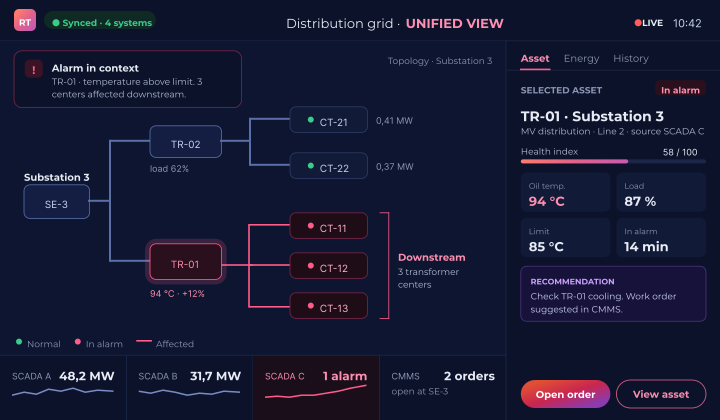
An isolated alarm says that something has gone out of range. With context, it says which asset is affected, which process it belongs to and what it means for the operation. That difference does not depend on having more data, but on that data being related. It is what separates seeing from operating, and the foundation on which analytics or artificial intelligence can work with coherent data instead of loose signals.
What to ask before adding a common layer
- How many SCADAs or other OT systems coexist today in your operation?
- Where does their data cross with maintenance, ERP, MES or reporting?
- Which decisions are still made with spreadsheets or manual reports?
- Do alarms arrive with asset, process and impact context?
- Is the goal just to visualize the data, or to turn it into operational actions?
Where this is heading
Our reading is that the SCADA will remain essential, but it will stop being the only place from which an operation is understood. Organizations with several control systems will move from asking which SCADA is best to asking how to make all of them work together. Whoever builds that common layer now will not have to rebuild it when operations grow. It is the same idea as a single data layer that we already see in other sectors.
Monitoring is seeing; operating is deciding
The question is no longer whether you have a SCADA, but whether everything it generates works together to improve maintenance, efficiency and reporting decisions. With the right infrastructure, the same data that today shows each part of the operation can explain the whole.
Leave a Reply